
The rupee plunged 90 paise to close at an all-time low of 80.86 (provisional) against the US dollar on Thursday after the US Federal Reserve's interest rate hike and its hawkish stance weighed on investor sentiments. Forex traders said the US Fed's rate hike and escalation of geopolitical risk in Ukraine sapped risk appetite. Moreover, the strength of the American currency in the overseas market, a muted trend in domestic equities, risk-off mood and firm crude oil prices weighed on the rupee.

All policy planners want low interest rate, says Jaitley

Infosys was the top gainer in the Sensex pack, rising over 2 per cent, followed by Bajaj Finance, HCL Tech, Tata Steel, Tech Mahindra and NTPC. On the other hand, Maruti, Sun Pharma, HUL and ITC were among the laggards. Nifty rose 122.15 points to 17,343.55.

Reserve Bank of India Governor Raghuram Rajan took charge of India's central bank when the rupee seemed to be in a tailspin while the country was facing runaway inflation.

A day after BRICS (Brazil, Russia, India, China and South Africa) nations agreed on a $100-billion foreign currency reserve pool to tackle the volatile foreign exchange markets, India on Friday said the pool would act as a buffer arrangement, adding it might not withdraw anything from this reserve.

'When I came here in 2002, I said you can grow at 8%.' 'And I was told that was crazy, and (now) here we are.'

From the peak of $3.67 trillion in January, India's market cap has eroded by $676 billion amid rising bond yields and a record-breaking sell-off by overseas investors.

Continuing their selling spree for the sixth consecutive month, foreign investors pulled out a massive Rs 41,000 crore from the Indian equity market in March on anticipation of rate hikes by the US Federal Reserve and deteriorating geopolitical environment amid the Russia-Ukraine war. Further, flows from foreign portfolio investors (FPIs) are expected to remain volatile in the near term given the headwinds in terms of elevated crude prices and inflation, experts said. According to data available with the depositories, FPIs were net sellers to the tune of Rs 41,123 crore in the equity market last month.

Foreign portfolio investors (FPIs) turned net buyers in October after being net sellers in the previous month. In October, FPIs bought shares worth nearly Rs 8,430 crore ($1 billion) against net selling of Rs 13,405 crore ($1.6 billion) in September. Positive flows during three of the previous four months have pushed the domestic markets towards fresh all-time highs. At present, the Sensex and Nifty are less than 2 per cent shy of breaching record highs logged in October 2021. A rally in equity markets in the US and Europe is in hopes that the Federal Reserve may go soft on rate hikes after its November meeting.

Inflation is expected to remain low in the near term, in part because of the further declines in energy prices.

It has been a slow 2022 thus far for the primary markets. In the last 8 months, only 16 companies have raised Rs 40,311 crore via the initial public offer (IPO) route, data from PRIME Database suggests. In comparison, 63 companies had raised a cumulative Rs 1.18 trillion via the IPO route in 2021. A large part of the funds raised in 2022 were on account of the two IPOs - Life Insurance Corporation of India (LIC) and logistics firm Delhivery - that raised a total of over Rs 26,000 crore between themselves.

Foreign institutional investors added $20.10 billion in equities while they pulled out $7.97 billion from the debt market, resulting in total net flows of $12.13 billion.
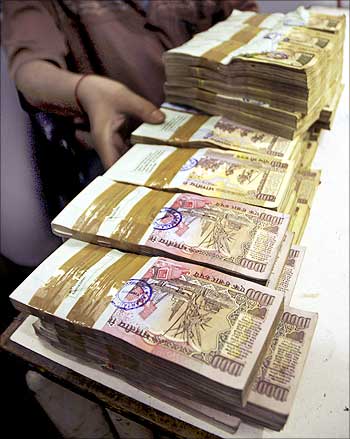
The local currency had gained 7 paise to close at 66.57 in Monday's trade.
The BSE mid-cap and small-cap indices ended flat against Sensex's 0.4% up-move.

IndusInd Bank was the top gainer in the Sensex pack, spurting over 8 per cent, followed by Axis Bank, ICIC Bank, Sun Pharma, SBI and Kotak Bank.

Market benchmark Sensex tumbled over 323 points after an intense last-hour sell-off on Wednesday, triggered by losses mainly in index heavyweights Infosys, Reliance and HDFC.

Hafiz Saeed's counsel said the "controversial" movie contains "malicious and filthy" propaganda against the Jamaat-ud-Dawa in general and Hafiz Saeed in particular.

The Bombay Stock Exchange benchmark Sensex has lost 478.60 points, or -2.80 per cent, to slip to 16,586.55 in afternoon trade on Thursday amid panic selling in markets worldwide following the US Federal Reserve's warning that the outlook for the world's largest economy is grim.

Improvements in the labour market has triggered this sentiment.
The RBI is expected to build reserves so the source of primary liquidity creation is backed by forex reserves.

In August, domestic equity markets garnered one of the highest foreign portfolio investor (FPI) flows since the outbreak of the pandemic in 2020, despite the US Federal Reserve standing firm on unwinding its stimulus measures to control inflation. FPIs pumped in over Rs 51,000 crore ($6.4 billion) in August, the most since December 2020 and the third-highest tally since March 2020-the month the Covid-19 pandemic roiled global markets. This was the second consecutive month of positive foreign flows. In the preceding nine months, FPIs had yanked out over $32 billion or Rs 2.2 trillion.

Tourism is badly affected. Entire apple orchards have been washed away. 2 million people are threatened with loss of livelihood.

'India seems to be on a relatively better wicket compared to other emerging markets.'

The rupee had ended lower by 19 paise at 56.15 against the dollar on wednesday as importers bought dollars in late trade.
Crucially, the US central bank softened the blow by making its forward guidance even more dovish.
The apex bank's observation on Tuesday comes at a time when global markets remain uncertain about the overall impact of the tsunami and the subsequently unravelling nuclear crisis in Japan.
On speculative front as well, non-commercials have decreased bullish bets on COMEX silver futures and options to a three-month low.

Sliding for the fourth straight day, the BSE Sensex shed 152 points in choppy trade on Wednesday amid mixed global cues ahead of the US Federal Reserve's policy decision.
Brazil and other developing nations are growing anxious about the expected withdrawal of stimulus in the United States
Barack Obama is likely to pick a candidate to succeed Ben Bernanke sometime during the summer.

Moody's has a 'Baa3' rating for India, with a positive outlook.
Second quarter earnings of companies, starting with the Infosys results, export-import numbers and industrial production data, could keep markets volatile in the week ahead.

Buffett said the economy is benefiting from improvement in areas that had not previously performed well, particularly homebuilding.
The 30-share BSE Sensex shed 0.9% or 186 points at 20,536 while the 50-unit NSE Nifty was off 1% or 61 points at 6,091.
Macro-economic data from China and minutes of the US Federal Reserve's last meeting caused the turmoil as stocks tumbled around the globe.
The Indian financial system is driven more by the domestic factors and "Fed rate cut is one of the triggers to review rates ", said Union Bank Bank of India chairman M V Nair.

M&M led the gainers' pack, spurting 2.76 per cent, followed by ITC, Kotak Bank, L&T, SBI, Bajaj Auto and Nestle India.
Mark Mobius, executive chairman of Templeton Emerging Markets Group still believes in the emerging markets growth story.

The home currency failed to keep momentum going and largely traded in a narrow range with positive bias in the absence of any market moving factors
The markets will also keenly eye the HSBC manufacturing and services data.
 © 2026 Rediff.com - Advertise with us - Disclaimer - Privacy Policy - Sitemap - Feedback - About us - Terms of use - Grievances